

Travel and life · Brisbane · In-depth article
Where do Moreton Bay's Far Eastern curlews go at high tide?
At Brisbane's Boondall Wetlands, start with the mud and a long, downcurved bill. What you can see changes as the tide moves in.
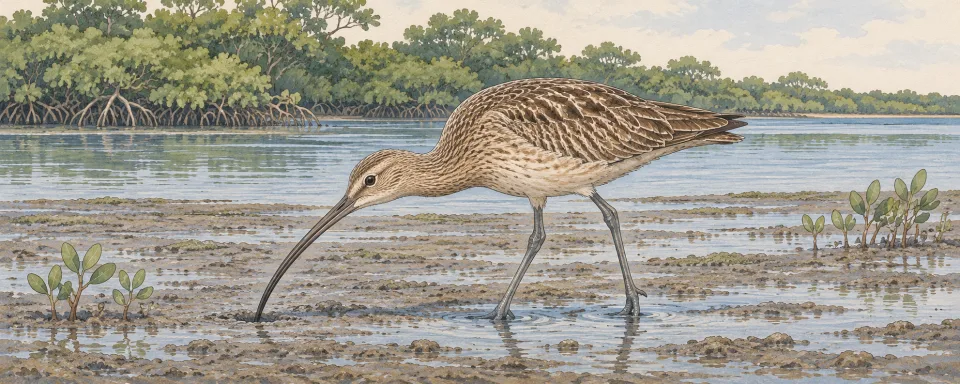
From the public tracks at Brisbane's Boondall Wetlands, watch what the tide leaves behind. If you see a grey-brown bird on long legs, take a look at the shape of its bill. A Far Eastern curlew has a very long one that curves down. The federal environment department lists October to March as a time to look for migratory shorebirds on exposed coastal flats. Which birds you find on a given walk depends on the tide and where the birds have settled. [S2][S3]
A bill that reaches into the mud
A feeding curlew will walk a little way, pause and work its bill into soft mud. Crabs and shrimps are among the foods described in the federal species profile. Other shorebirds can have curved bills too. Use binoculars to take in the size and shape of the whole bird before trying to name it. Then watch where the tip of the bill goes. [S2]
Water over the flats means a move
When the tide covers the feeding ground, shorebirds move to places where they can rest above the water. At Moreton Bay these can include dry sandy or rocky shorelines and the edges of mangroves. The birds shift with the height of the water, the weather and how much disturbance there is. Far Eastern curlews travel along the East Asian–Australasian Flyway, relying on places such as the Yellow Sea mudflats to stop and feed in both directions. [S1][S2]

For a better chance of seeing a bird probe for food, check a tide prediction near your viewing point and pick a daylight visit on a falling tide or near low water. At Boondall, stay on the public track or in a bird hide. If birds are looking up or edging away, give them more room. Once the water is up, scan the sand that is still exposed from where you are. A visit without a curlew can still show how much changes with a tide. [S1][S3]
Comments
Share a related experience or ask about the article
No comments yet. Ask a question about the article.
Sign in to discussKeep the discussion about the content. Do not post private information or advertisements.